What Actually Happens on a Weekly Pool Service Visit
Eleven small jobs, done in a set order, are the reason a pool looks effortless by the time you walk out to it.
October 27, 2026 · 4 min read
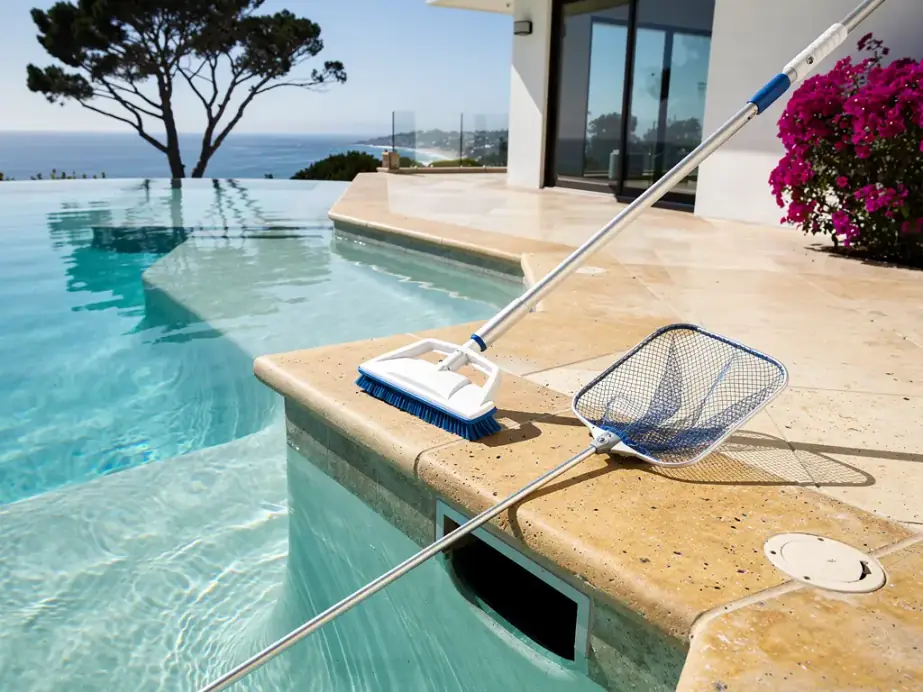
If you have a pool in La Jolla and someone comes by every week, you probably see the truck, the pole and the test kit, and then you see clear water. What happens in between is a sequence of small jobs, and each one is there for a reason. Zach's Pool Service lists an 11 step visit on its website, and this article walks through it in order so you know what the work is and what a good visit leaves behind.
Zach is a certified swimming pool technician (License # T5450) and the business is small and owner operated, so the checklist below is the one he works from for residential in-ground pools and spas. Not every step applies to every pool: a pool with no salt system skips the salt cell, and a pool with a cartridge or sand filter has no D.E. to recharge.
Start with the water and the equipment
Step one is "Check chemical balance of pool." Before anything is added, the water gets tested. The readings tell the technician what the pool has been through since the last visit: a hot stretch, a windy week, a pool party, a rainstorm. Testing first means chemicals are added in response to what the water is actually doing, instead of on a fixed routine that ignores the week.
Step two is "Turn on and examine equipment." The pump, filter and any salt system or heater get a look while they're running. Listening matters here. A pump that sounds different from last week, a filter gauge that has crept upward, or a small drip at a union are all easier to deal with when they're caught early. A weekly visit gives one person the chance to notice slow changes that an owner walking past the equipment pad every day would never catch.
Salt cell and filter
Step three reads "Clean salt system cell if applicable, and on an as-needed basis." A clean cell is left alone. When mineral scale has built up on the plates, the cell gets cleaned so it can keep making chlorine. Step four is "Recharge the D.E. filter with diatomaceous earth, if applicable." That step belongs to pools with a D.E. filter, where the powder coating on the filter grids is what catches fine dirt.
Skim, vacuum and brush
Step five is "Skim pool surface and vacuum," and step six is "Brush pool walls." Skimming lifts leaves, insects and blossoms off the surface before they sink and break down. Vacuuming picks up what has already settled on the floor. Brushing loosens the thin film and the first traces of algae that cling to walls, steps and corners, places where circulation alone doesn't reach. Once that material is loose it can be carried to the filter instead of staying put and growing.
These are the jobs you can see, and they only work well when the machinery behind them is sound. That's what the rest of the list covers.
The cleaner, the baskets and the pump
- Step seven: "Examine and adjust auto cleaning system." The auto cleaner's hose, wheels, bag or brushes wear out and drift out of adjustment, and a cleaner that isn't moving properly leaves the same patches dirty every week.
- Step eight: "Empty skimmer baskets." A full skimmer basket restricts flow to the pump and lets debris sit in the water instead of being caught.
- Step nine: adjust and maintain equipment, which includes backwashing the filter and emptying the pump basket. The pump basket protects the impeller from leaves and bits of debris.
- Step ten: "Lubricate o-rings, unclog impellers, and/or adjust valves." A dry o-ring on a pump lid or filter fitting is how air gets into the system, and a clogged impeller is a common reason for weak flow.
None of these are exciting, and all of them help keep a repair bill from showing up later. A pump that pulls air or an impeller choked with debris will cut circulation quietly, and water that doesn't circulate doesn't filter.
Chemicals go in last
Step eleven is "Implement chemicals." It comes at the end on purpose. By then the pool has been skimmed, vacuumed and brushed, the baskets are empty, the equipment is running as it should, and the water is moving. Chemicals added into a pool in that state mix through quickly and do their job. Added at the start, they'd be fighting the debris and the weak circulation that the earlier steps are meant to fix.
What it looks like from your side
One customer review on Google describes the result this way: "Always on time each week, and consistently good cleaning. The pool is left so clean, the water is clear, and the filter is cleaned out well." That's the visible end of the list above. The filter being cleaned out well is step four and step nine. The clear water is step eleven. Being on time every week is just how the routine holds together.
You can help the visit go well in small ways. Keep the gate and the equipment area accessible, tell Zach if you've noticed a new noise, a puddle, a slow cleaner or a change in how the water looks, and let him know about anything unusual that went in the pool, such as a large party or a lot of runoff after rain. Those details save time and help him find the cause faster.
If you'd like weekly service for your La Jolla pool or spa, call Zach's Pool Service at (619) 678-2240 or use the contact page.
Zach's Pool Service, (619) 678-2240
Call (619) 678-2240More articles
D.E. Filters Explained: Recharging and Why Backwashing Matters
A D.E. filter catches very fine dirt, but only while its grids wear a fresh coat of powder.
Why Salt System Cells Scale Up, and When They Need Cleaning
The white crust on a salt cell is mineral scale, and it's one reason a salt pool can still run low on chlorine.